

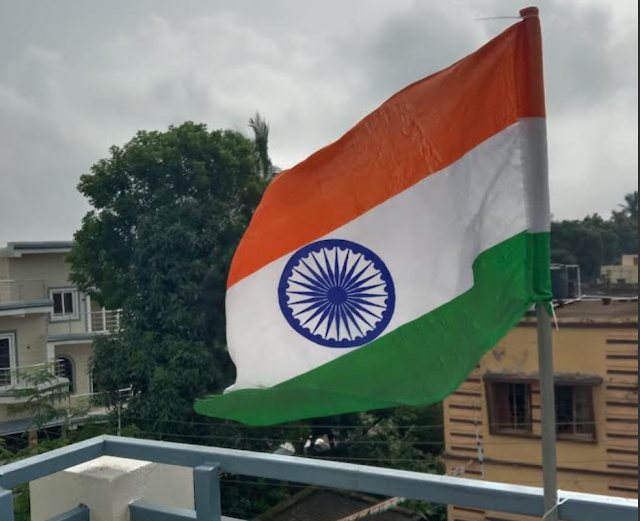
Imagine a flag that isn’t stitched in a big factory, or made by industry 4.0 but spun by hand, thread by thread, fiber by fiber selected in a small village. Well, That’s the story of our Tiranga (Indian National Flag).
It all begins with Khadi— Handspun and Handwoven with care.
But now the question arises why khadi?
Well, that dates back to pre-freedom years, at the time of freedom movement, when Mahatma Gandhi picked up a charkha. He asked every Indian to spin their own cloth. He called it Swadeshi— “by us, for us.” So that we no more depend on clothes made in Britain. And then later that became the symbol of “us”. When India became free, our leaders wanted a flag that carried that same spirit hence they wrote it into the Flag Code of India: The national flag must be made only of khadi. And hence the same continues
Now let’s dig deeper into this matter. At first, only cotton khadi was allowed. Today, the Bureau of Indian Standards also permits silk and wool khadi, but with one rule that never changed — it must be handmade. And so, our flag was born with 3 equal bands — saffron for courage, white for truth, green for faith — and a navy-blue Ashoka Chakra with 24 spokes right in the center.
Khadi Isn’t Just a Cloth. It’s a Message
Now let’s proceed with the story of Khadi that is carried with our tiranga. It is the Story of Self-Reliance carried with unity, the story of dignity bonded with strength and the story of respect that keeps our Livelihood.
1. The Story of Self-Reliance
A khadi Tiranga says: “We made this ourselves.” It refuses foreign dependence. It stands for a nation that builds its own future.
2. The Story of Unity
Anyone could spin khadi. A scientist of West Bengal, a farmer in Punjab, a teacher in Kerala, a student Bihar. And when all these threads come together, they became one flag. That’s India — different hands, one Tiranga.
3. The Story of Dignity
Because it’s handmade, the flag carries the fingerprints of rural artisans. It isn’t cold or machine-made. It’s warm, with the effort of real people woven into it.
4. The Story of Strength
Khadi doesn’t give up easily. It holds its color in the sun, doesn’t tear in the rain, and doesn’t slip on the flagpole. That’s why the same flag can fly over government buildings for days.
5. The Story of Respect
To protect its dignity, only BIS and KVIC licensed units can make the official flag. No cheap copies. No misuse. Just one standard for the whole country.
6. The Story of Livelihood
Every official Tiranga buys a meal for a weaver, a spinner, a dyer in a village. Khadi keeps an old craft alive and gives work to thousands of families.
In short: Khadi turned the Tiranga from just 3 colors into the heartbeat of India.
Where Is This Magic Woven?
If you’ve ever seen the flag, go up at the Red Fort on 15th August, or at Rashtrapati Bhavan, know this — it came from one tiny place.
Bengeri village, near Hubballi in Dharwad district, Karnataka.
Here sits the Karnataka Khadi Gramodyoga Samyukta Sangha — KKGSS. It’s the only BIS-certified unit in India allowed to make the official national flag.
Now let’s understand how it’s done,
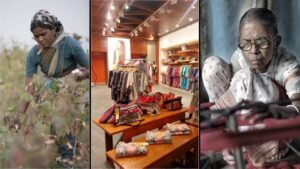
First, in Tulasigeri and Bagalkot, artisans hand-spin and weave the khadi.
Then it travels to Bengeri, Hubballi where, women artisans dye it saffron, white, and green. Then the Ashoka Chakra is printed with exact 24 spokes. They stitch the 3 panels together and check every flag — 3:2 ratio, perfect colors, perfect chakra. This workshop was started in 1957 by freedom fighter Venkatesh Magadi. In 2006, it got the official license to make India’s flag.
During Independence Day and Republic Day, the women here work for day and night. Because millions of flags need to reach every corner of India, and one flag needs to reach the top of the Red Fort.
There used to be another unit in Borivali, Mumbai. But today, if it’s an official Tiranga, it has to be born in Bengeri.
So, in conclusion it’s needles to mention that Tiranga is not just a simple khadi fabric it’s the symbol that carries the emotion of 140 crores so the next time you see the Tiranga fluttering, remember:
It’s not just a fabric.
It’s freedom, spun by hand.
It’s unity, dyed in three colors.
It’s India, woven in one village and flown by 140 crore people.
Sources:
https://en.wikipedia.org/wiki/Karnataka_Khadi_Gramodyoga_Samyukta_Sangha






Leave a Reply